Parks in Kolkata serve as the green lungs of a dense, historic metropolis, offering a sanctuary where the city’s frantic pace dissolves into the rustle of ancient leaves and the shimmering reflections of sprawling lakes. To understand the botanical landscape of Kolkata is to start with the Maidan, an unparalleled 1,283-acre expanse in the heart of the city that acts as its “Garher Math” (Field of the Fort). Exploring Kolkata covers many parks in Kolkata.
This vast urban green space is not just a park but a historical theater where the Victoria Memorial’s white marble glows at sunset, the Eden Gardens stadium roars during cricket matches, and horse-drawn carriages evoke a bygone era.
It is a place where professional athletes, amateur footballers, and grazing sheep coexist under the watchful eyes of colonial-era statues, making it the most democratic space in Bengal.
Moving toward the fringes of the city, the Acharya Jagadish Chandra Bose Indian Botanic Garden in Shibpur stands as a 270-acre testament to 18th-century scientific ambition, housing the world-famous Great Banyan Tree, which, with its 250-year-old canopy and thousands of aerial roots, appears more like a forest than a single organism.
In the modern planned township of New Town, the Eco Park (Prakriti Tirtha) represents the city’s 21st-century evolution spanning 480 acres, it is India’s largest urban park, featuring a massive 100-acre water body for boating, meticulously curated themed gardens like the Japanese Forest and Butterfly Garden, and the popular “Seven Wonders” replicas that draw thousands of families every weekend. There are so many parks in Kolkata to explore.
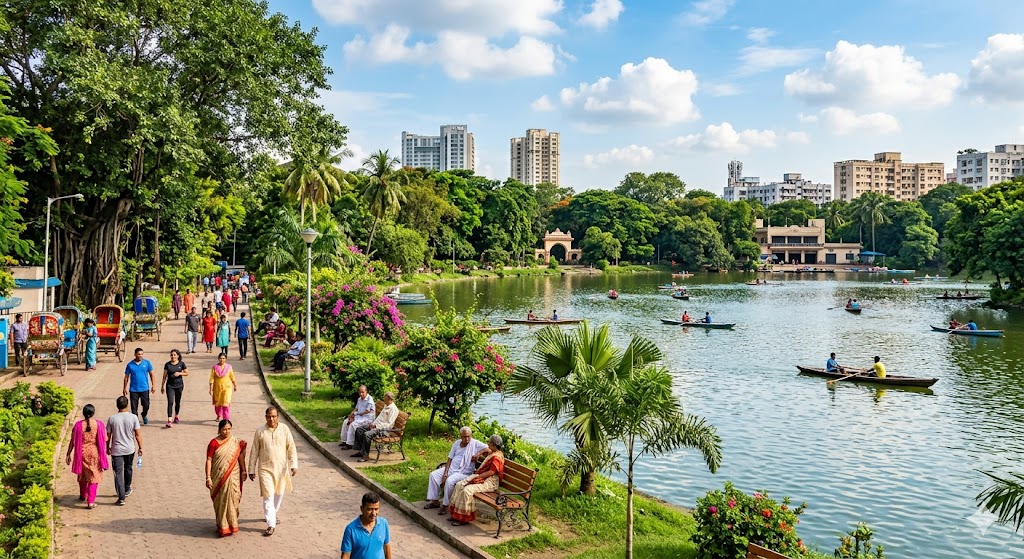
Meanwhile, in the southern part of the city, Rabindra Sarobar (The Lakes) provides an ecological haven where migratory birds settle on the water and the city’s rowing clubs slice through the calm, offering a leafy retreat for morning walkers and fitness enthusiasts who navigate its winding, shaded trails.
Parks in Kolkata in more details.
Further east, Central Park in Salt Lake (Banabitan) offers a quieter, more biodiverse experience with its expansive rose gardens and a pagoda-crowned island that feels worlds away from the nearby IT hubs. For those seeking more intimate escapes.
Elliot Park near the Park Street crossing provides a manicured oasis of fountains and paved walkways built on reclaimed land, while Millennium Park along the Hooghly riverfront offers a panoramic view of the Howrah Bridge, where the cool breeze from the river provides a respite from the tropical heat. These parks are not merely aesthetic additions to the skyline but are essential social institutions where the legendary Bengali “adda” flourishes, where lovers find seclusion behind trimmed hedges, and where the biodiversity of the Gangetic delta is preserved against the encroachment of concrete, collectively forming a verdant network that keeps the soul of Kolkata alive.